


Different Types of Wedding Veils
Picture a cathedral veil sweeping behind your gown or a soft lace edge framing your face as you walk down the aisle.
Always give yourself room to try something unexpected, too!
This guide to wedding veils explores the lengths and styles, with advice on choosing one to suit your dress and hairstyle.

Common Wedding Veil Lengths – By Bridal Accessory Experts
A wedding veil length is often the first decision brides make when choosing a veil.
A short veil keeps the focus on your dress and your face. A longer veil adds drama the moment you step into the room.
Short and elbow-length veils
A short veil sits somewhere between the shoulders and the elbows, and it works especially well with detailed necklines.
An elbow-length veil falls a little further, just past the elbow, and gives your veil a bit more presence without trailing behind you.
Birdcage veils sit at the shortest end of the scale. They’re a small net of veiling, often vintage in feel, clipped close to the head rather than draping down the back.
A birdcage wedding veil suits a bride who wants her hair and her dress to lead her wedding day look, with the veil as a finishing touch rather than the main event.

Fingertip and waltz veils
A fingertip veil, as the name suggests, reaches to where your fingertips naturally fall when your arms are relaxed by your sides. It photographs beautifully, and the shorter length keeps it clear of the floor during the reception.
A waltz veil falls between the knee and ankle, giving you a longer sweep of fabric that moves with you on the dance floor without trailing along the ground.

Chapel and cathedral veils
Chapel and cathedral veils trail behind you as you walk down the aisle, adding drama to your entrance.
A chapel-length veil has a shorter sweep, while a cathedral-length veil extends further behind you.
How far either trails depends on your height, where you attach it and the length of your dress train.
A chapel veil offers the ceremonial impact of a long veil with less fabric trailing behind you. Both lengths can look especially striking in a venue with a long aisle.
A longer veil can complement fuller ballgowns and dresses with a train, allowing the wedding dress and veil to flow together. It can also create a sweeping outline behind a fitted gown.

Different Types of Wedding Veils by Style
Length isn’t the only way to categorise a wedding veil style.
Shape, fabric and where the veil sits on your head also influence how it frames your face and falls around your dress.
Mantilla veils
A mantilla veil is edged in lace all the way around, usually mounted close to the head rather than gathered at the crown, so it frames the face the way a traditional lace mantilla would.
The look is romantic and a little vintage, and it pairs beautifully with a dress that already has lace or embroidery detail. The two textures echo each other faultlessly.
Birdcage and Juliet cap veils
Beyond the short birdcage style, a Juliet cap veil takes its name from a close-fitting cap, often beaded or pearl-trimmed, worn low on the forehead with the veiling attached at the back.
It’s a distinctly retro look, closer to 1920s and 1930s bridal fashion than the flowing veils most people picture.
It works particularly well for brides wearing their hair down or in soft waves rather than swept up.
Blusher veils
A blusher is a layer of veiling worn forward over the face as you walk down the aisle.
It can be lifted when you reach your partner or later in the ceremony, depending on how you’d like that moment to unfold.
Some brides choose a blusher on its own for a simple, understated look.
Paired with a longer veil, it gives you that romantic unveiling moment, with the longer layer flowing behind your gown.

Choosing Between Single-Tier and Multi-Tier Veils
Tiers are the layers of your veil. Their number, along with the fabric and gathering, influences how softly it drapes and how much fullness it has.
Single-tier veils
A single-tier veil has one layer of fabric, usually soft illusion tulle, falling behind you. It can be gathered at the top for fullness or left ungathered for a smooth, delicate drape.
A plain single-tier veil is often a lovely choice with a heavily embellished wedding gown, letting the dress’s detail show through the sheer fabric.
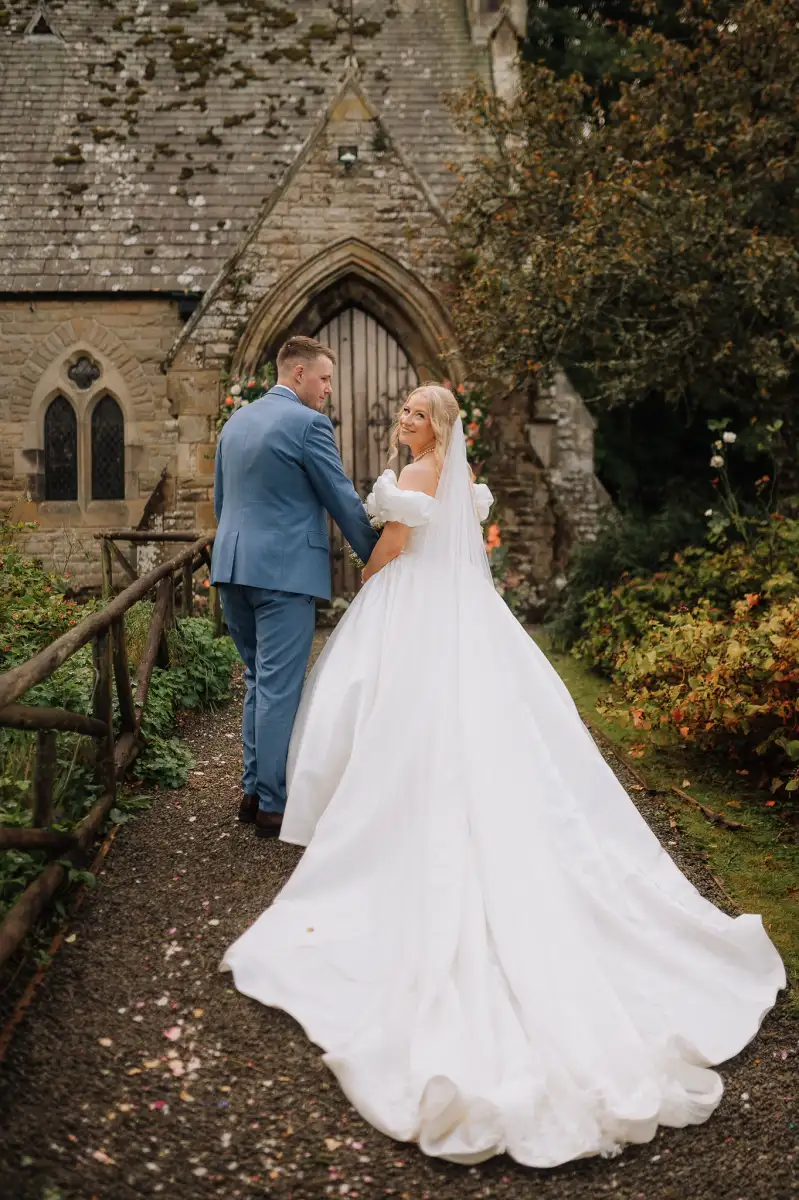
Multi-tier and layered veils
A multi-tier veil typically has two or more layers, often at different lengths. The shorter front layer can form a blusher, while the longer veil extends down your back.
Gathered layers create a fuller shape, with folds of tulle moving around your shoulders as you walk. A drop veil can have front and back layers without gathering at the top, giving it a flatter, softer drape.
Veils are also often finished with satin ribbon, pearl trim or scattered beadwork to pick up detail from the dress.
Choosing a Wedding Veil for Your Dress and Hairstyle
When choosing a wedding veil, consider how its length and fullness complement your dress silhouette.
Different wedding dress styles can give the fabric a different shape to fall around, helping you see which is the right veil for the look you want.
A structured ballgown can carry a longer, fuller veil, with layers of tulle flowing over the skirt. A fingertip veil can complement the clean lines of a sheath or fit-and-flare dress, while a longer veil adds a sweeping train.
Where you attach your veil also shapes your finished bridal look. A veil attached high, near a bun or an upstyle, sits differently to one clipped lower into loose waves.
If you’re planning to wear your hair down on the day, wear it down for your accessories appointment too. Seeing your veil with your bridal hairstyle can help you envision your journey down the aisle.
Choosing by wedding theme
For an outdoor or barn wedding, a shorter veil means less fabric trailing over grass or gravel, while a longer style of veil can look beautiful sweeping down a long aisle, bringing a sense of drama to your entrance.
When choosing a veil for your dress, picture yourself wearing it in your venue. Seeing different veil options with your gown can help you imagine the look you want for your ceremony.
But most important of all, you should choose the veil that you feel happiest in.
Wedding veil FAQs
Do I have to wear a veil for my wedding?
Not at all. Plenty of brides choose a fresh flower crown, a statement headpiece, or nothing at all in their hair. A veil is a beautiful traditional wedding veil option, but it’s entirely your choice whether to wear one.
Can I wear a veil with a detailed or lace wedding dress?
You can, and it often looks stunning, though it’s worth trying it in person first. A plain tulle veil generally works best against a heavily embellished dress, while a lace mantilla veil suits a simpler gown, so the lace has room to stand out rather than competing with matching lace on the dress itself.
Should my veil be longer than my dress train?
No fixed rule exists, but many brides find a veil the same length as the train, or a shorter veil worn just above it, keeps the silhouette balanced from behind. If your dress has a dramatic cathedral train, a veil of a similar length tends to read as one continuous line rather than two separate layers.
Can I wear a veil with my hair down?
Yes, and it’s a popular choice, especially with softer veil styles like a Juliet cap or a single-tier drop veil. A comb secured close to the crown, just behind where your hair naturally parts, usually holds a veil securely even with loose waves.
How do I secure a wedding veil in my hair?
Most veils attach with a comb sewn into the top layer, which slides in against the roots and locks into place. For finer hair or an updo under a lot of tension, a few extra grips on either side of the comb keep everything steady throughout your wedding day.
Find Your Perfect Wedding Veil at Bijoux
Trying different veil styles with your gown can bring a lovely surprise.
Just like your chosen dress, a veil you’d never have picked yourself might turn out to be exactly right once you see it in the mirror.
Come and explore our bridal veils with a glass of prosecco in hand. Our stylists will help you find a look you love and show you how to look after your accessories in the lead-up to your big day.
Call us on 01698 200122 or book your appointment online, and find the perfect wedding veil to complete your dress.

