


Structured vs Unstructured Wedding Dresses
Every wedding dress falls somewhere on a spectrum.
At one end is a sculpted, corseted bodice that holds its shape alone. At the other, a soft, flowing gown moves the moment you do.
Neither one is the “right” choice. They’re simply two beautifully different ways of feeling incredible on your wedding day.
But getting to know what each one offers is the best place to start your dress shopping experience.
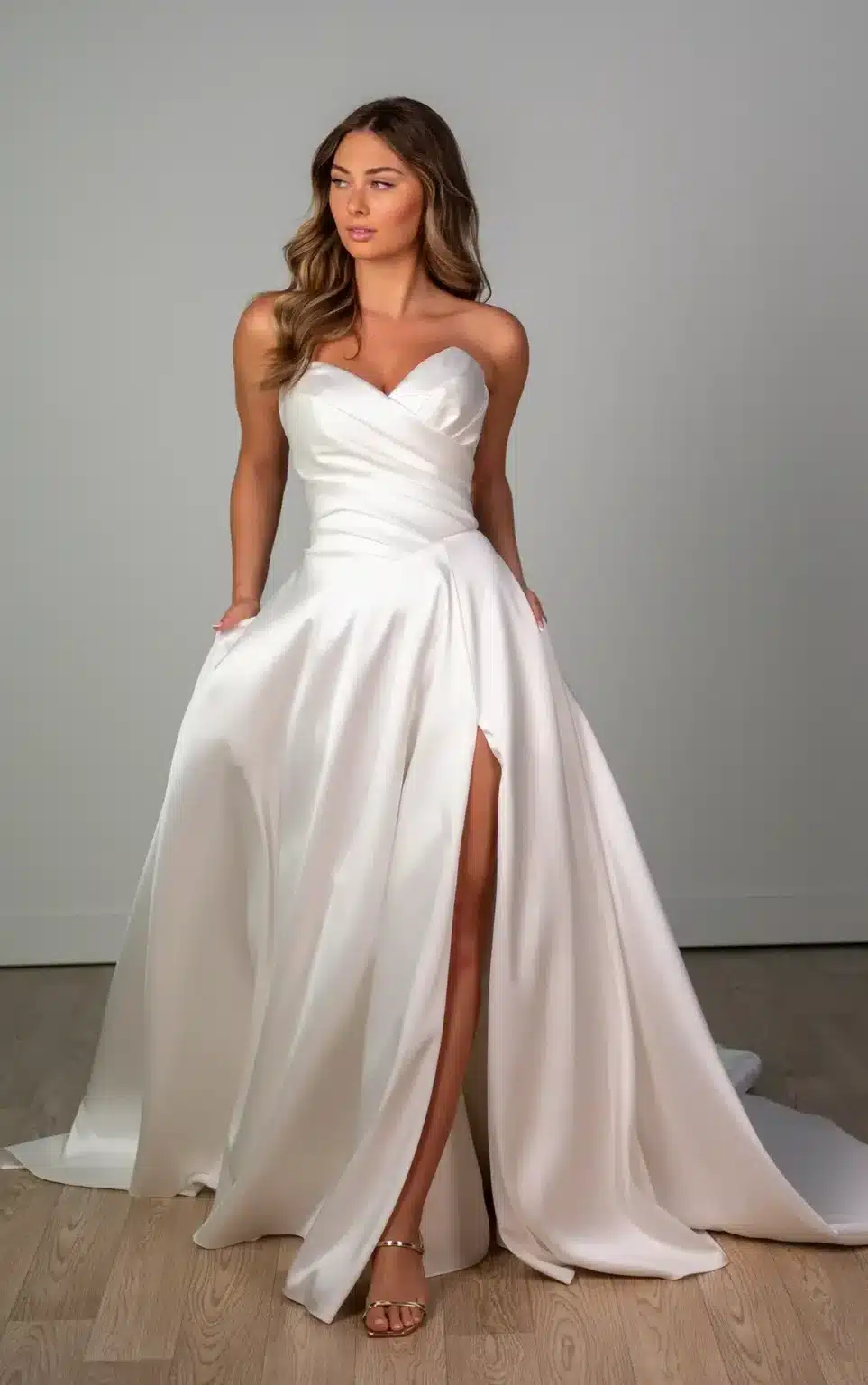
Both structured and unstructured dresses can be found in our Made to Order, Quick Delivery, or Off-the-Peg collections.
What makes a dress structured
Support and boning
A structured wedding dress is designed with built-in support, usually boning stitched into the seams of the bodice.
A corset-style back laces or zips to hold everything in place. The dress essentially does the work of shapewear, which is why so many structured gowns need little or nothing underneath.
The boning itself is usually lightweight strips of plastic sewn into the seams of the bodice, or flexible steel on a more heavily boned gown.
It’s spaced to follow your dress’s natural lines. It’s the same principle as traditional corsetry, just designed into the gown rather than worn separately underneath.
Fabric, fit, and skirt shape
Fabrics like duchess satin and mikado hold their own shape too, giving structured dresses that crisp, sculpted look even before the boning comes into it.
A strapless dress or a sweetheart neckline leans on this kind of structure especially, since the bodice needs to stay put all on its own.
Backless structured styles manage the same trick with hidden clasps or a corset lace-up instead of straps.
Structured gowns also tend to hold a fuller skirt beautifully, since a defined waist and bodice give a dramatic silhouette something firm to build from.
Full ballgown skirts, layers of tulle, and voluminous trains often pair with a structured bodice for exactly this reason.
What makes a dress unstructured
Fabric and drape
An unstructured wedding dress is designed with softness in mind. Fabrics like chiffon, crepe, and silk are left unlined or minimally lined. The gown skims the body and moves freely, rather than holding a fixed shape.
An unstructured dress has little to no boning involved, and the silhouette relies on the drape of the fabric itself rather than a built-in foundation.
Bias-cut gowns fall into this category too, cut on the diagonal grain so the fabric has natural stretch and flow.
Where you’ll see it
Sheath and slip-style gowns are the classic unstructured shape, following the body’s own line from shoulder to hem without a defined waist seam.
Softer necklines tend to suit this kind of gown too, since there’s no rigid bodice holding a stronger neckline in place.
Layers of soft tulle or organza can still add volume to an unstructured gown without adding structure.
The fullness comes from stacking fabric rather than from a boned foundation. The dress keeps that same floaty, unfixed quality even with plenty of skirt to it.

How each one feels to wear
What each one feels like
A structured gown has a wonderful sense of being held. Brides who love that supported, sculpted feeling often say it makes them stand taller.
The corset back can be laced to fit the day perfectly, even if you’ve had a glass of champagne or two at the reception.
An unstructured gown feels like a second skin. It’s light, breathable, and easy to dance in. That’s part of why so many brides choose an unstructured style for an outdoor ceremony, or a wedding day that’s all about movement and ease.
There’s a real effortless elegance to a gown that moves when you do.
Both feelings are wonderful. It really is about which one sounds more like you on the day itself.
Practical differences to know
There are a few practical differences worth knowing early in your wedding planning too.
A structured bodice with a fitted lining can run a touch warmer over a long reception. An unstructured gown in a breathable fabric like chiffon tends to feel cooler.
Neither is a reason to rule a style out on its own. But it’s the kind of detail our stylists will happily talk through if it matters to you.
Movement changes between the two as well, particularly for a first dance.
A structured gown moves as one shaped piece, while an unstructured gown ripples and flows with every step, which photographs beautifully in its own way.
If you’re planning a destination wedding, an unstructured gown is usually the easier one to pack and travel with too.
What to wear underneath
Structured dresses tend to need the least underneath, since the bodice and boning are already doing the shaping. A
structured gown is often the low-maintenance choice on the underwear front, and wearing a strapless style rarely means worrying about extra layers underneath.
Unstructured gowns are more likely to call for a lightweight slip or seamless underwear, simply because there’s less fabric doing the structural work.
Our stylists will always talk you through exactly what a particular gown needs when you find one you love.
Accessorising each style
A structured gown carries a statement veil or a dramatic headpiece beautifully.
The strong lines of the bodice give a bolder accessory something to balance against. Cathedral veils, sparkling belts, and detailed gloves all tend to sit well with a more sculpted silhouette.
Unstructured gowns usually call for something softer. A blusher veil, delicate hair vine, or simple pair of earrings lets the movement of the dress take centre stage.
Neither approach is a rule, just a starting point for the rest of your wedding wardrobe. Our stylists can help you build on it when it comes to bridal accessories.
Shape and structure are two different things
An A-line dress or a fit and flare dress describes the shape of the skirt, not whether the bodice is structured.
Structure in a wedding dress lives in the bodice, not the skirt shape. Either dress style can be designed with a fully boned bodice or with none at all.
It’s worth asking about the bodice specifically, rather than assuming a shape automatically comes with structure, or without it.
That holds true across the many categories of wedding dresses you’ll come across while dress shopping.
Structure isn’t all or nothing
Plenty of gowns blend the two rather than sitting in one camp.
A structured, corseted bodice paired with a soft, flowing skirt is one of the most popular combinations in bridal right now. It gives you a supported feeling up top, with movement and ease through the rest.
Two-look gowns take this further still, with a structured base underneath and a detachable overskirt you can remove for the party.
You get the best of both silhouettes across a single wedding day. It’s exactly the kind of dress style our selection of designer gowns includes plenty of.
Whichever you choose, our independent seamstress handles wedding dress alterations for structured and unstructured gowns alike.
Once your dress arrives, the fit is exactly right on the day. Buying a wedding dress always includes this step, whichever bridal dress you fall for.
Finding your dress
There’s no wrong choice
There’s no universally better option between structured and unstructured, and no single perfect dress that suits every dress journey the same way.
Some brides know instantly they want that sculpted, held-in feeling. Others fall for the first flowing gown they try on and never look back.
Most brides genuinely don’t know which they’ll prefer until they’ve felt both on. That’s true for every bride, whatever style you had in mind before you arrived.
Finding the perfect wedding dress is rarely about knowing in advance. It’s about noticing how a dress looks and feels once it’s on.
Those are the moments we love witnessing at Bijoux.
Try both at your appointment
That’s exactly what a bridal appointment at Bijoux is for. Come and try on both. Feel the difference between a corseted bodice and a soft, unlined gown, and let our stylists pull styles based on what you’re drawn to.
They’ll clip and pin each one so you can see exactly how it will sit on the day. With so many styles to choose between, you’re part of the Bijoux community from the moment you arrive.
You’re surrounded by friends who are all there to hype you up while you find your dress, whichever silhouette that turns out to be.
Book your appointment today and come feel the difference between structured and unstructured for yourself, the only way to know which one is truly yours.

